
Your buyers have started asking AI assistants which vendors to consider, and the assistants are answering.
So I ran a study to find out what those answers actually say: when a B2B buyer asks ChatGPT, Claude, or Gemini which vendors to shortlist, who shows up, and why? What I found should change how you think about visibility. Here’s the method and the findings.
The short version: AI assistants don’t return a list of links the way search does. They return an answer, usually a short list of vendors with a citation or two behind it. If a brand isn’t in that answer, it doesn’t exist for that buyer. So the real question isn’t where you rank, it’s whether you get cited at all.
How I ran it
I built 110 prompts that mirror how buyers shop when they’re close to a decision, the kind you’d type when you’re ready to shortlist vendors rather than just browsing. I ran each one across the three assistants buyers are using, then read every answer line by line: every brand named, every URL cited, every domain referenced.
That gave a dataset worth standing behind:
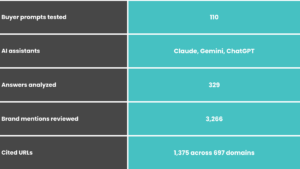
The prompts spanned eight categories so the patterns weren’t tied to one market: marketing, cybersecurity, HR technology, supply chain, manufacturing, fintech, analytics, and enterprise software. For each answer I tracked the same things, brands mentioned, sources cited, what type of source it was, how often domains recurred, how much the engines agreed with each other, and whether the cited pages were even reachable by AI crawlers.
What I found
Getting named is not the same as getting trusted.
Across the dataset, 60.6% of brand mentions had no source behind them. The assistant knew the name but couldn’t point to anything backing it up. For big, familiar brands that recall comes for free. For everyone else, a citation was the only way in. Familiarity without evidence turned out to be a dead end, the brands winning these answers weren’t the most famous, they were the most cited.
Reddit out-cited Gartner. Nobody planned for that.
The single most-cited domain in the whole set was Reddit, ahead of G2, Gartner, and vendor blogs. LinkedIn, the platform every B2B marketer lives on, accounted for less than 1% of cited URLs. Peer threads are shaping AI recommendations more than analyst reports are. Put bluntly, the thought leadership we publish on LinkedIn is barely reaching these systems, and the community content we tend to ignore is doing the citing.
There isn’t one AI answer to optimize for. There are three.
Same question, three assistants, three almost entirely different sets of vendors and sources. Only 3% of cited domains showed up across all three, and on roughly one in six questions the engines named zero brands in common. Optimizing for one assistant and calling it your AEO strategy is like doing SEO for a single search engine and ignoring the rest. Buyers see a different shortlist depending on where they ask.
Comparison pages are the highest-leverage page you can build.
Comparison and “alternatives” pages made up 29.2% of all citations, and when the prompt itself was a comparison question that jumped to 56.3%. The assistants weren’t surfacing the About page. They were surfacing the page that answers “why this product over that one.” Most brands don’t have those pages, which is exactly why it’s an opening.
Most sites are invisible before the conversation even starts.
73% of the sites I looked at had settings that accidentally block AI crawlers, robots.txt rules and heavy JavaScript rendering written for search bots, not AI retrieval. A brand can’t be cited if it can’t be read, which means the citation problem often starts well before content strategy does. It starts with access.
AI citations and Google rankings have come apart.
7.8% of the pages AI assistants cited don’t rank in Google’s top 10 for the same query. That’s not noise, it’s a real split. These systems are trusting content that search hasn’t rewarded, which means optimizing for Google no longer guarantees you show up in AI answers. They’ve become two different problems that need two different strategies.
What this means:
Pulling it together, a few things are clear enough to act on:
- Build for citation, not just visibility. The win is a URL inside the answer, not a position on a results page.
- Comparison and alternatives pages are the fastest opening. They’re heavily cited and most brands haven’t built them.
- Community matters more than we treated it. Reddit and forums are part of the citation layer now, not a nice-to-have.
- Check crawlability first. If AI can’t read the page, nothing else we do counts.
- Treat each assistant separately. There’s no single answer to optimize for.
AEO is the work we do at Proxy: figuring out how a given category actually gets cited, then building the pages, fixing the access problems, and earning the citations that put our clients inside the answer.
If you’re wondering whether your brand shows up when buyers ask, that’s exactly the question we help answer.
Reach out at hello@proxyagency.com.